Chinese mobile AI assistants increasingly support regional speech varieties, but the term “dialect support” does not refer to a consistent product capability across platforms. Depending on the assistant, it may describe the ability to recognize dialect input, respond using the same dialect, or provide a selectable voice with regional speech characteristics.
This study compares the dialect related settings available in five Chinese mobile AI assistants: HONOR YOYO, Huawei Celia, OPPO Xiaobu, vivo Xiao V, and Xiaomi XiaoAI. The comparison is based on direct observation of the settings interfaces and the operating system versions recorded in the study worksheet.
The results show that all five assistants expose dialect related functionality, but they implement it at different stages of the voice interaction process.
Study Scope
The study records three types of information:
* Whether a dialect related feature is available * How many dialect types or dialect voices are listed * How the feature is presented and configured in the product interface
The tested software versions recorded in the study are:
| Platform | Assistant | Tested OS Version |
|---|---|---|
| HONOR | YOYO | MagicOS 10.0.0.125 |
| Huawei | Celia | HarmonyOS 6.0.0.130 |
| OPPO | Xiaobu | ColorOS 16.0.5.702 |
| vivo | Xiao V | OriginOS 6.1.12.5 |
| Xiaomi | XiaoAI | HyperOS 3.0.7.0 |
This is a settings level availability study. It does not measure recognition accuracy, response quality, latency, dialect authenticity, or task completion performance.
Results at a Glance
| Assistant | Dialect Related Implementation | Coverage Recorded in the Study |
|---|---|---|
| HONOR YOYO | Automatic dialect recognition without prior configuration | 12 dialect types |
| Huawei Celia | Recognition and replies using the same dialect | 7 dialects |
| OPPO Xiaobu | Selectable regional and dialect voice options | 5 voices |
| vivo Xiao V | Selectable dialect and local language voices | 7 voices |
| Xiaomi XiaoAI | Dialect conversation and recognition only modes | 2 conversation dialects and 3 recognition only dialects |
The figures cannot be interpreted as a single ranking. Each product counts a different type of capability. HONOR counts recognized dialects, Huawei counts dialects supported in two way interaction, while OPPO and vivo count selectable voices.
HONOR YOYO

HONOR presents its dialect feature as “Dialect Free Talk.” The interface states that no setup is required and that users can switch freely between supported speech varieties during recognition.
The supported range includes Mandarin and the following 12 dialect labels:
* Cantonese * Sichuan dialect * Chongqing dialect * Northeastern Mandarin * Henan dialect * Hebei dialect * Shandong dialect * Guangdong dialect * Anhui dialect * Hunan dialect * Shaanxi dialect * Tianjin dialect
The interaction model prioritizes automatic recognition. Users do not need to select a specific dialect before speaking.
Based on the supplied screenshot, the confirmed capability is dialect recognition. The interface does not state whether YOYO also replies using the same dialect.
Huawei Celia
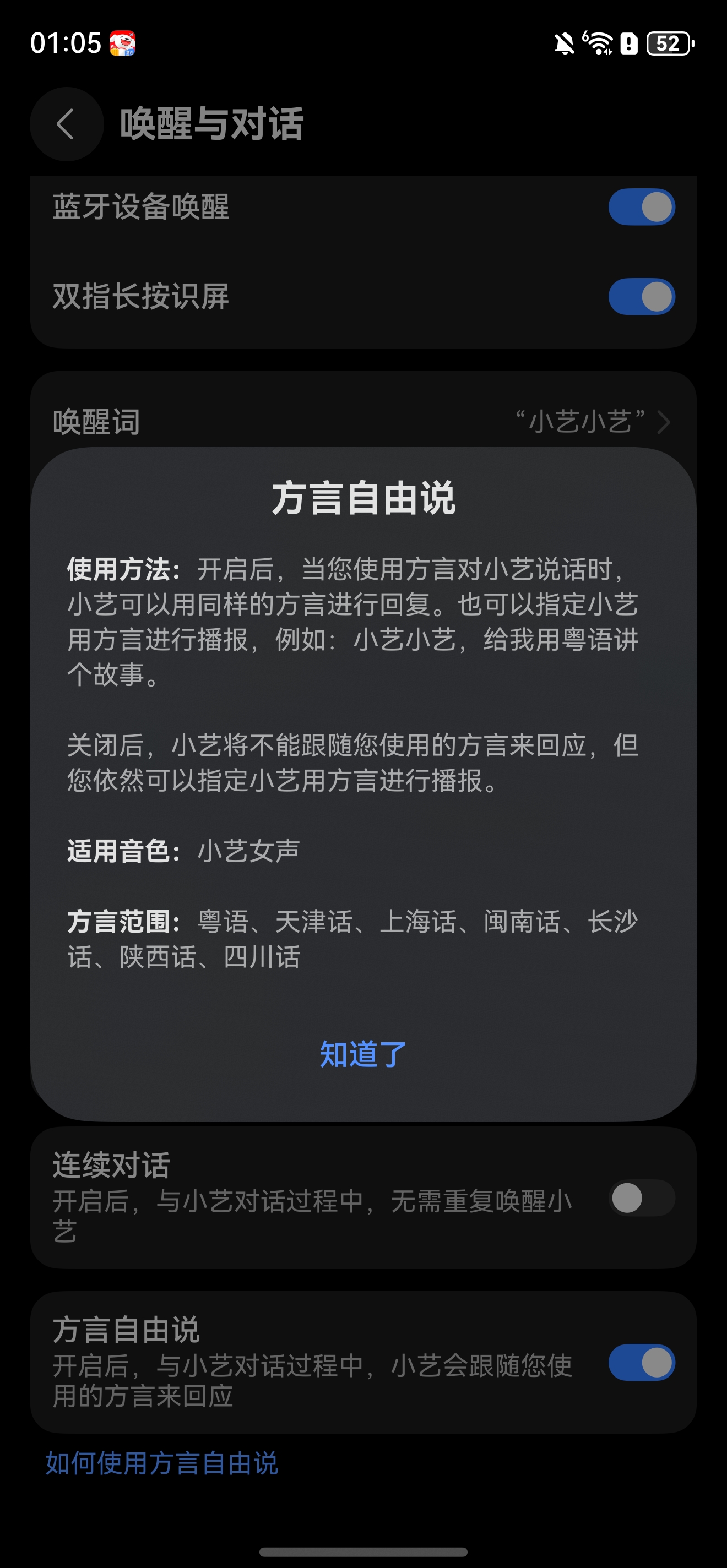
Huawei also labels its feature “Dialect Free Talk,” but the documented behavior is more extensive.
When the feature is enabled, Celia can respond using the same dialect spoken by the user. Users can also explicitly request dialect output, such as asking Celia to tell a story in Cantonese.
The interface lists seven supported dialects:
* Cantonese * Tianjin dialect * Shanghainese * Southern Min * Changsha dialect * Shaanxi dialect * Sichuan dialect
Huawei separates automatic dialect following from explicitly requested dialect output. When the setting is disabled, Celia no longer follows the dialect used by the speaker automatically. The user can still request that Celia speak in a specified dialect.
The feature is shown as compatible with the Celia female voice. The supplied materials do not indicate whether other Celia voices can use the same dialect functionality.
OPPO Xiaobu
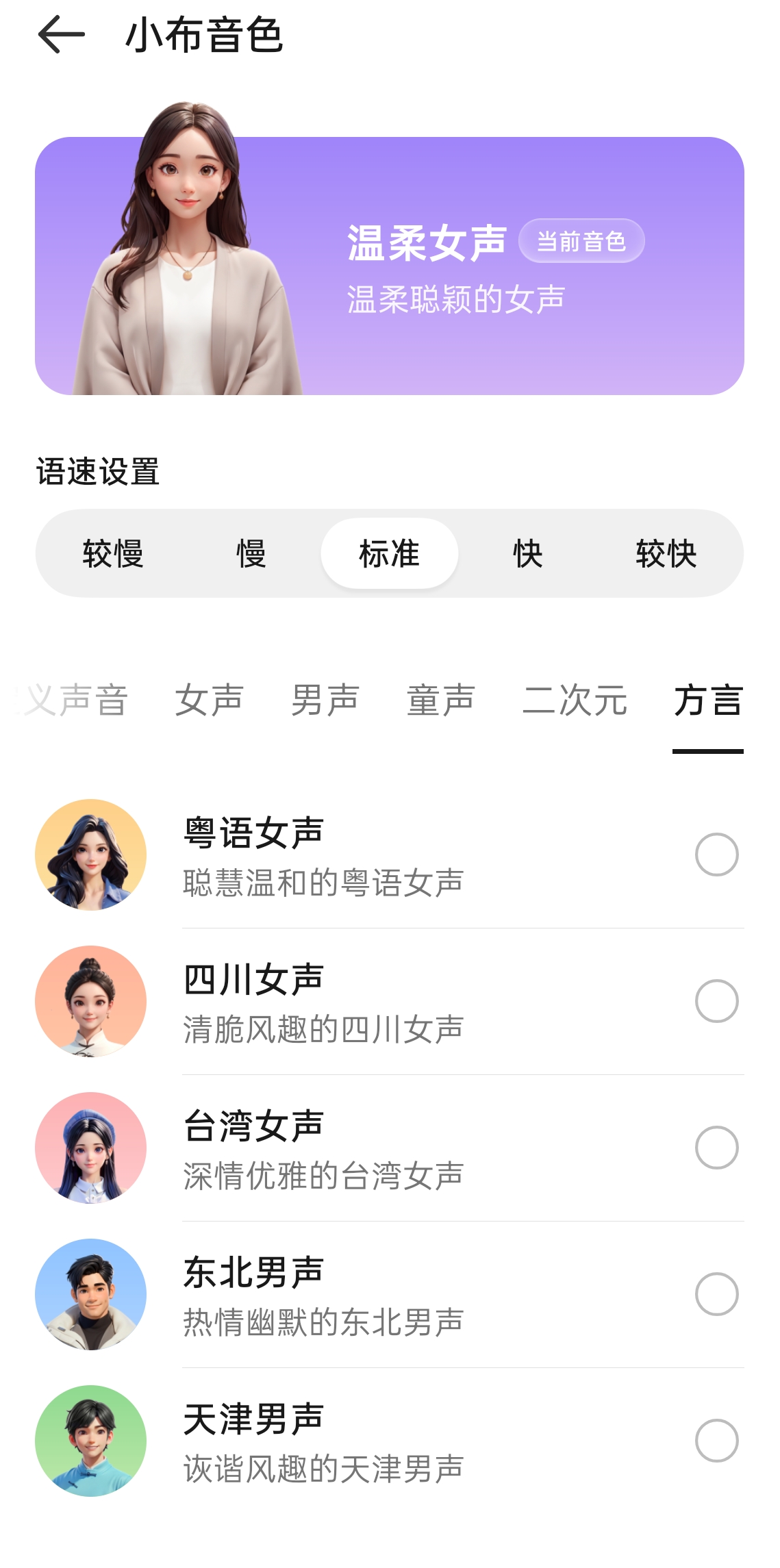
OPPO places dialect related options inside the Xiaobu voice selection interface. The feature is presented as a category of available voices rather than a separate recognition or conversation setting.
Five regional voices are shown:
* Cantonese female voice * Sichuan female voice * Taiwan female voice * Northeastern male voice * Tianjin male voice
Each option combines a regional label with a predefined gender and voice character. This makes dialect part of the assistant’s voice personalization system.
The screenshot confirms that users can select these voices for Xiaobu. It does not establish whether Xiaobu can recognize the corresponding dialects when spoken by the user or automatically switch between them during a conversation.
vivo Xiao V
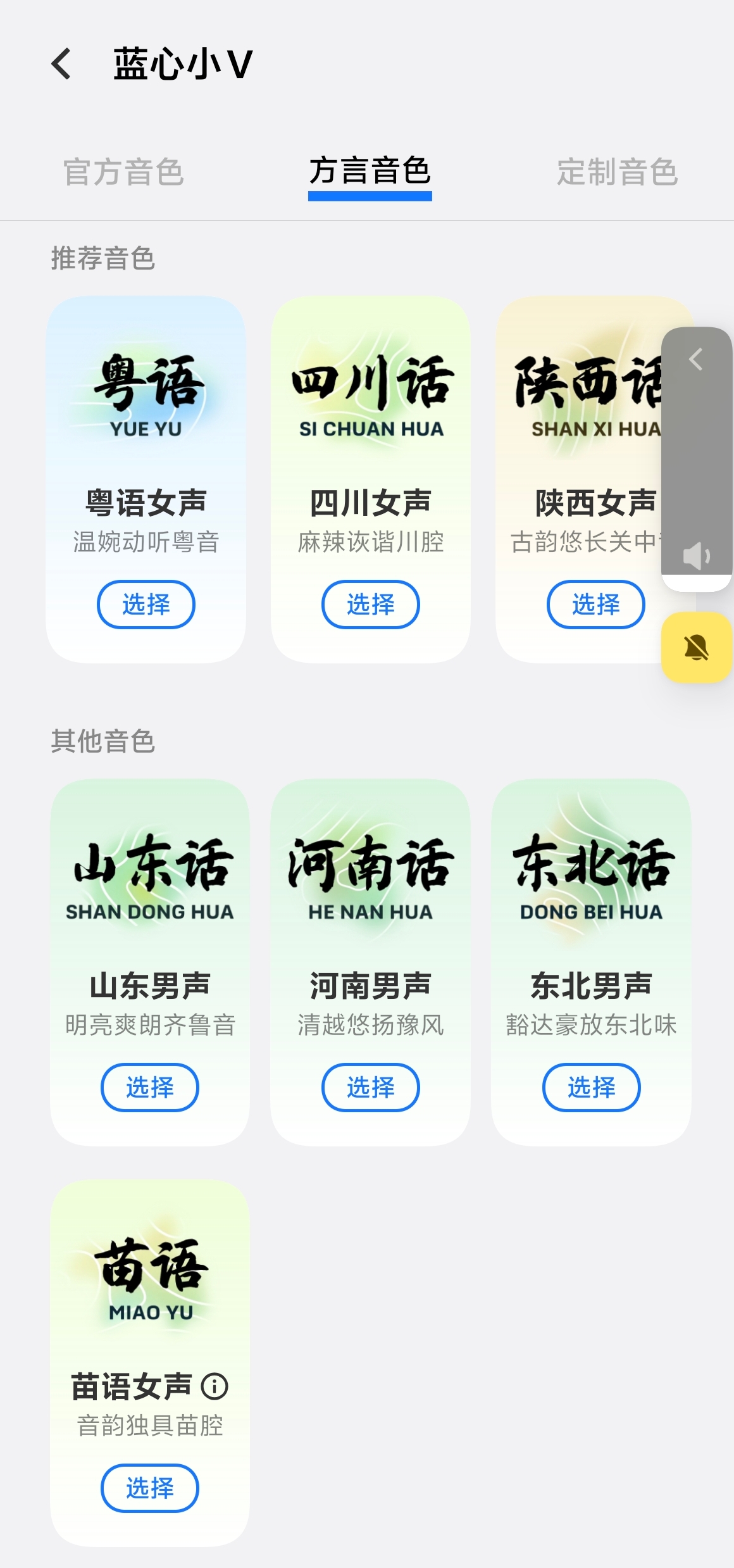
vivo provides a dedicated “Dialect Voices” section within the BlueLM Xiao V voice interface.
Seven voice options are shown:
* Cantonese female voice * Sichuan female voice * Shaanxi female voice * Shandong male voice * Henan male voice * Northeastern male voice * Miao language female voice
The interface presents each option as an individual voice profile with its own regional label, gender and descriptive personality.
As with OPPO, the supplied evidence confirms voice output options. It does not confirm whether Xiao V recognizes these speech varieties as user input or supports automatic same dialect replies.
The inclusion of Miao language in the dialect voice category also shows that vivo’s product classification includes both Chinese dialects and other local language varieties within the same voice selection system.
Xiaomi XiaoAI
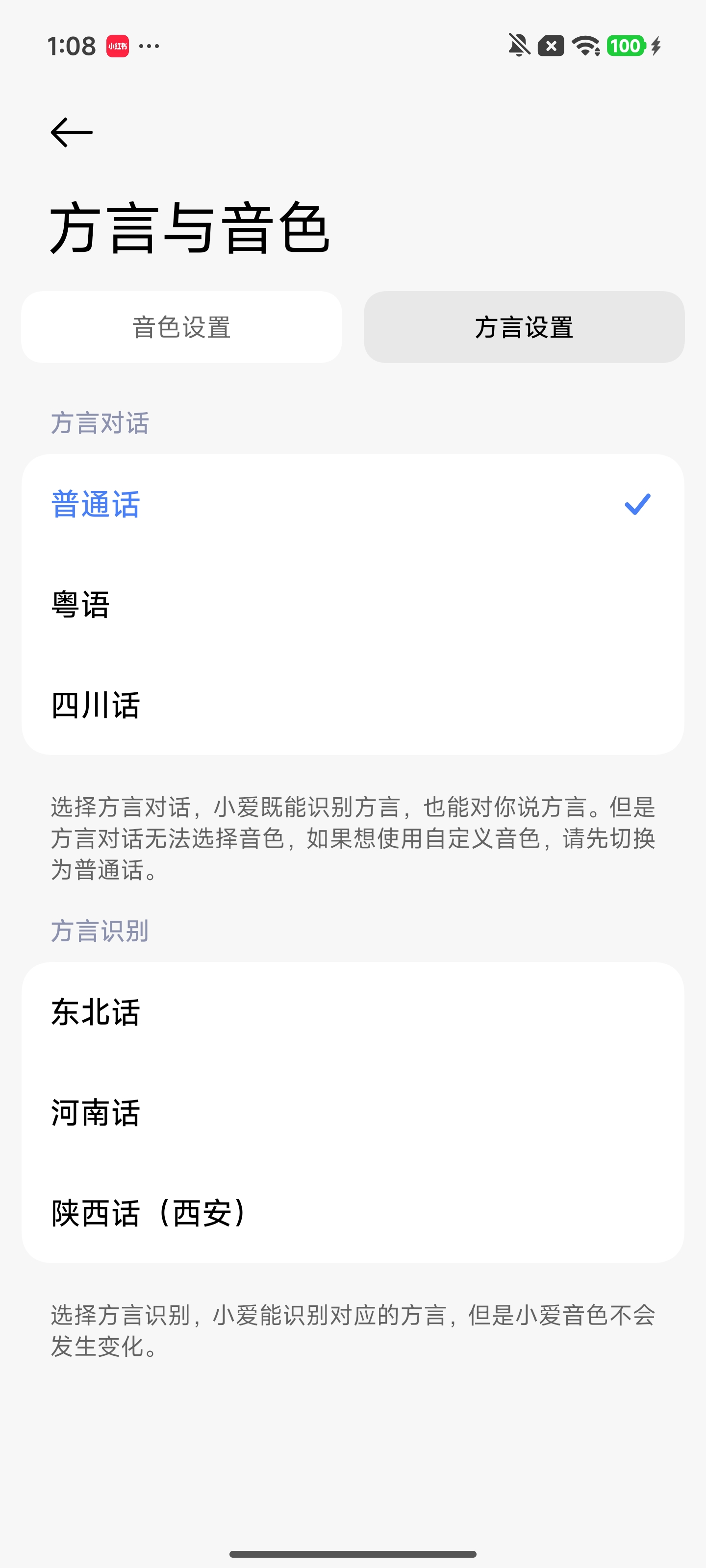
Xiaomi provides the clearest distinction between dialect conversation and dialect recognition.
Under “Dialect Conversation,” the interface lists:
* Cantonese * Sichuan dialect
The setting description states that XiaoAI can both recognize these dialects and speak them back to the user. Mandarin is also available as the default conversation option, but it is not counted as a dialect in the study worksheet.
Under “Dialect Recognition,” the interface lists:
* Northeastern Mandarin * Henan dialect * Shaanxi dialect, specifically the Xi’an variety
For these three varieties, XiaoAI can recognize the user’s speech, but its output voice does not change.
The interface also states that custom voices cannot be selected while dialect conversation is active. Users must switch back to Mandarin before using a custom XiaoAI voice.
Xiaomi therefore exposes the difference between input recognition and full dialect conversation directly in the settings architecture.
Comparative Findings
Dialect support refers to different capabilities
The five assistants use similar terminology for features that perform different functions.
HONOR focuses on automatic input recognition. Huawei supports recognition and same dialect replies. Xiaomi separates dialect conversation from recognition only modes. OPPO and vivo primarily expose regional speech through selectable assistant voices.
A binary “supported” or “not supported” comparison would hide these implementation differences.
HONOR provides the broadest documented recognition range
HONOR lists 12 dialect types in addition to Mandarin and requires no manual selection before use. Among the supplied materials, this is the broadest documented dialect recognition range.
The current evidence does not show whether the assistant’s response language changes to match the user.
Huawei provides the broadest documented same dialect reply coverage
Huawei lists seven dialects for its Dialect Free Talk feature and explicitly states that Celia can reply using the same dialect as the user.
It also supports direct requests for dialect speech output, even when automatic dialect following is disabled.
Xiaomi makes the capability boundary visible
Xiaomi explicitly distinguishes dialects that support a complete conversational exchange from dialects that are limited to recognition.
Two dialects support both recognition and speech output, while three additional dialects are recognition only. This distinction gives users a clearer expectation of how each mode will behave.
OPPO and vivo treat dialect as voice personalization
OPPO and vivo organize dialect related features as voice choices. Their interfaces emphasize voice identity, gender and regional character.
The supplied evidence supports a conclusion about speech output customization, but not about dialect input recognition or bidirectional dialect conversation.
Key Takeaways
All five assistants in the study provide some form of dialect related capability, but their implementations are not directly equivalent.
HONOR offers the broadest documented dialect recognition coverage and removes the need for manual configuration. Huawei supports the largest documented set of dialects with same dialect replies. Xiaomi provides fewer full conversation dialects but clearly separates conversation support from recognition only support. OPPO and vivo use dialect primarily as a voice personalization feature.
The study also shows why raw dialect counts require context. Twelve recognized dialects, seven conversational dialects and seven selectable voices represent different parts of the voice assistant experience. Future comparisons should continue to distinguish input recognition, response language and voice output rather than combining them into a single dialect support metric.
Limitations
The study is based on the feature descriptions and options visible in the supplied settings interfaces. It confirms the availability and stated scope of each feature but does not verify real world performance.
The following areas were not tested:
* Speech recognition accuracy * Completion of assistant tasks initiated in dialect * Stability during continuous conversation * Switching between Mandarin and dialect within the same session * Naturalness and regional authenticity of generated speech * Behavior with unsupported dialects * Differences across devices or later software versions
These areas would require a separate controlled interaction test using standardized prompts and native or proficient speakers of each dialect.